
Trash management is a core janitorial responsibility because janitorial teams perform the internal collection, source segregation, interim containment, and on-site consolidation that keep a facility safe, clean, and cost-controlled. Without this work running on a defined schedule, bins overflow, recycling gets contaminated, pests find footholds, and hauling costs climb. Routine janitorial trash duties typically include:
- Emptying desk-side and common-area bins on a set schedule
- Collecting waste from restrooms and break rooms
- Separating basic recyclables at the source
- Relining receptacles with the correct bag gauge
- Moving consolidated waste to a central on-site collection point or dumpster
One boundary matters here: licensed hauling, regulated hazardous waste handling, and off-site disposal are separate services, governed by different industry classifications and legal requirements.
Key Takeaways
Trash management is a core janitorial function because internal collection, source segregation, and on-site consolidation directly control safety, hauling costs, contamination rates, and occupant experience in every commercial facility.
| Point | Details |
|---|---|
| Janitorial scope ends at the dumpster | Internal collection and consolidation are janitorial duties; off-site hauling requires a licensed NAICS 562 vendor. |
| Regulated waste requires immediate escalation | Sharps, chemical waste, and RCRA-regulated materials must be isolated and handed to licensed specialists. |
| Contamination drives hidden costs | Recycling contamination triggers load rejections and surcharges; signage and bin placement are the lowest-cost fix. |
| Contracts must name the handoff point | Specify the exact location and time window where janitorial responsibility ends and hauler responsibility begins. |
| AMWS Group manages the full internal program | AMWS Group provides waste-stream assessments, route optimization, training, and 24/7 support to close operational gaps. |
Table of Contents
- Why trash management belongs inside janitorial operations
- Clear scope: what janitorial teams do vs. what waste specialists handle
- Operational best practices: an audit checklist for facility managers
- How janitorial work hands off to waste haulers
- AMWS Group closes the gaps that cost facilities the most
- Sources
- FAQ
Why trash management belongs inside janitorial operations
Overflowing bins are not just an eyesore. They create slip-and-fall hazards, attract pests, generate odor complaints, and signal to occupants that the facility is not being managed well. Each of those outcomes carries a real cost, whether measured in pest-control invoices, tenant complaints, or extra hauler pickups triggered by avoidable overflow.
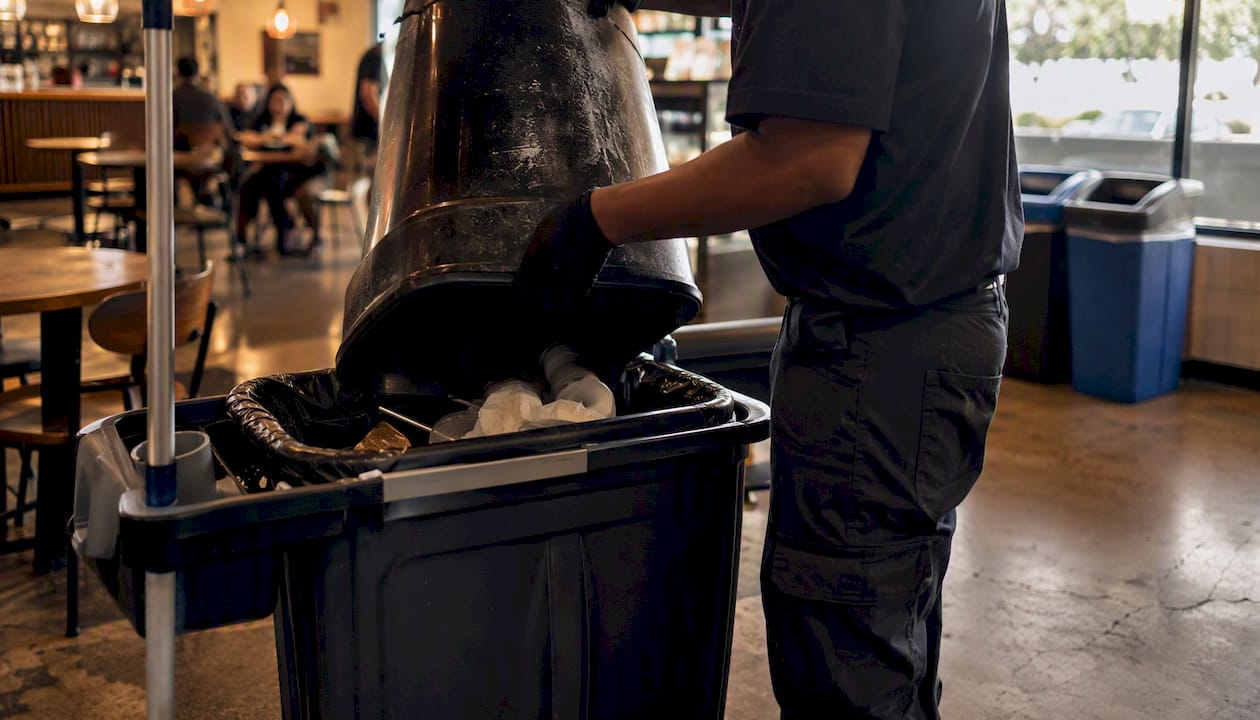
Treating waste as a managed flow rather than a fixed line item reveals opportunities to reduce hauling frequency, lower contamination rates, and improve cleanliness with measurable visibility into volumes and diversion rates. That shift in framing is what separates facilities that control waste costs from those that simply pay whatever the hauler bills.
Contamination in recycling streams is one of the most expensive and overlooked failures. When general trash ends up in a recycling bin, the entire load is often rejected and sent to landfill, which eliminates any diversion credit and can trigger surcharges. Strategic bin placement and clear signage are among the highest-impact, lowest-cost measures available to reduce that contamination. Janitorial teams are the daily enforcement mechanism for those placements.
When internal trash handling runs well, the downstream benefits compound. Hauling frequency drops, contamination penalties disappear, sustainability reporting improves, and occupant complaints about odor or overflow fall sharply. None of that happens without janitorial staff executing a consistent, well-designed collection program.
Clear scope: what janitorial teams do vs. what waste specialists handle
The practical boundary is straightforward: janitorial teams own everything from the bin to the on-site dumpster or compactor. Once waste crosses that threshold for off-site transport, licensed haulers take over. Confusion about where one responsibility ends and the other begins is the single most common cause of full bins sitting unaddressed and missed pickups going unreported.
| Janitorial / Internal Collection | Waste Specialist / Licensed Hauling |
|---|---|
| Empty desk-side and common-area bins | Scheduled off-site hauling from dumpster or compactor |
| Reline receptacles with correct bag gauge | Manifested hazardous waste transport and disposal |
| Separate basic recyclables and organics at source | Medical sharps collection and certified destruction |
| Move consolidated bags to on-site dumpster | RCRA-regulated chemical waste handling |
| Maintain cleanliness around loading dock staging area | Large-scale remediation and spill response |
| Monitor bin fill levels and report overflow | Materials recovery and processing at licensed facilities |
The Resource Conservation and Recovery Act (RCRA) sets federal standards for hazardous waste management in the United States. Any waste stream that falls under RCRA, including chemical drums, certain batteries, and manifest-required materials, requires a licensed handler. Assigning that work to janitorial staff is both a compliance violation and a safety risk. The U.S. Census Bureau’s NAICS classification places janitorial services in subsector 561 and waste hauling and treatment in subsector 562, a structural separation that reflects exactly this operational and legal divide.
Pro Tip: Contract language should name the precise handoff point, for example, “janitorial team consolidates waste to the loading dock staging area by 10 PM; hauler pickup begins at 6 AM.” Without that specificity, both parties assume the other is responsible for the gap, and bins stay full.
Operational best practices: an audit checklist for facility managers
Consistent collection, low contamination, and a predictable hauling cadence are the three markers of a trash program that is actually working. If any one of those is missing, cost and complaints follow. Use the steps below to audit your current program or build a new scope of work.
- Conduct a waste-stream assessment. Walk every zone and count bin types, sizes, and fill rates over one week. A single baseline audit typically exposes opportunities to reduce hauls and cut disposal costs, depending on current diversion options.
- Right-size receptacles by zone. A small desk-side bin and a large break-room bin have different collection needs. Matching container size to actual generation volume prevents both overflow and unnecessary trips.
- Sequence collection routes logically. Routes should move from clean zones (offices) to higher-volume or higher-risk zones (break rooms, restrooms, loading docks) to avoid cross-contamination and reduce backtracking.
- Standardize bag gauge and liner type. Thin liners tear, spill, and slow collection. Specify the correct gauge for each bin type in the scope of work so janitorial staff are not improvising.
- Reline immediately after emptying. A bin without a liner is a contamination risk. Relining at the point of collection, not at the end of a shift, is the standard that prevents odor and pest issues.
- Implement odor control at high-risk points. Break rooms, restrooms, and loading docks need more frequent collection or odor-control products. Schedule those zones at higher frequency than general office areas.
- Secure the loading dock and dumpster area. Unlocked dumpsters attract unauthorized dumping, which inflates hauling costs and creates liability. Assign a janitorial staff member to check dock security at the end of each shift.
- Post signage at every bin cluster. Right-sized containers paired with clear signage reduce janitorial labor time and disposal costs while improving diversion rates.
For KPI tracking, monitor these metrics monthly: contamination rate by stream, pickups per week by zone, average time per collection route, cost per cubic yard of waste hauled, and staff time saved after route optimization. UC Davis Facilities, for example, publishes cleaning and waste management schedules separately, which illustrates how institutions formalize the distinction between custodial collection and waste services in their operating models.
Pro Tip: When selecting bins, prioritize ergonomic design: foot-pedal lids, smooth-rolling wheels on larger containers, and handle placement that reduces bending. Equipment that is easier to service gets serviced faster and with fewer injuries, which directly lowers labor cost and turnover.
How janitorial work hands off to waste haulers
A successful handoff program defines four things in writing: the pickup point, the collection schedule, the notification protocol when something goes wrong, and the escalation path for missed pickups or contamination disputes. Without all four, gaps are inevitable.
Contract clauses and service-level expectations that every facility manager should verify:
- Handoff point: Name the exact location where janitorial responsibility ends and hauler responsibility begins (loading dock bay number, compactor pad, or designated staging area).
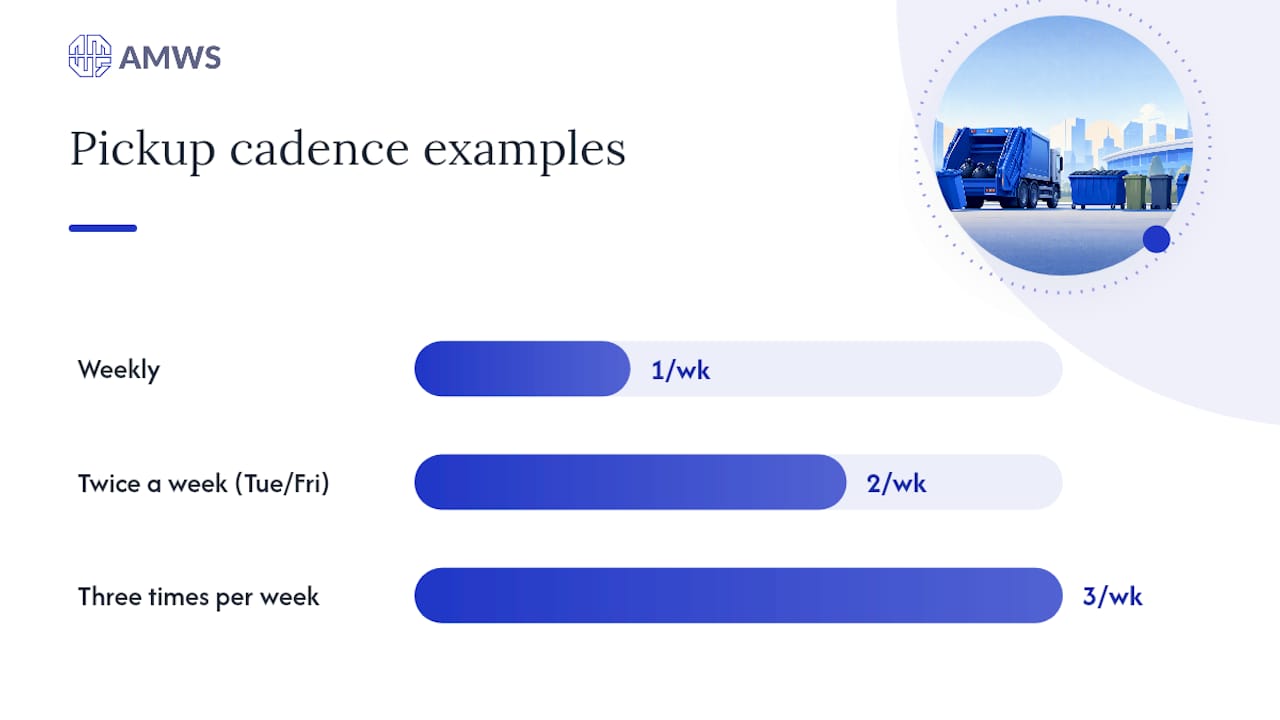
- Hauler frequency: Specify pickup days and times, not just “weekly.” A Tuesday/Friday schedule means something different to a hauler than “twice a week.”
- Contamination response: Define who is responsible for sorting costs when a load is rejected, and set a timeline for resolution.
- Missed-pickup penalties: Include a credit or rebooking clause so a missed pickup triggers an automatic response rather than a phone call that may or may not happen.
- Liner and bin supply: State explicitly who provides liners, replacement bins, and recycling containers. Ambiguity here creates supply gaps that stall janitorial operations.
- Night-shift handoff protocol: If janitorial staff consolidate waste after business hours, the contract must address dock access, security codes, and who is notified if the staging area is full.
Common failures in this handoff look like: a janitorial team that consolidates waste to the dock at 11 PM but the hauler’s access window opens at 7 AM with no security clearance on file; a recycling bin that fills by Wednesday but the hauler only comes Friday; or a night-shift supervisor who has no contact number for the hauler when a compactor jams. Each of those is a contract gap, not an operational mystery.
For cost control, audit dumpster volume quarterly. Many facilities pay for a pickup cadence set years ago that no longer matches actual generation. Reducing hauls from three times per week to two, after improving source segregation, can cut hauling costs without any change in service quality. Cleaning contracts with explicit terms around waste handling and hauler coordination are one of the most direct levers for controlling that cost.
When trash becomes a regulated or specialized job
The decision to escalate is not complicated, but it must be made quickly. The workflow is: isolate the material, notify the facilities supervisor, and engage a licensed handler if the waste is regulated. Do not continue routine handling once a regulated material is identified.
Regulated waste streams that require specialist handling include:
- Sharps and medical waste: Any needle, lancet, or biohazardous material requires certified collection containers and a licensed medical waste hauler. Janitorial staff must never handle loose sharps.
- Chemical waste and RCRA-regulated materials: Chemical drums, certain solvents, and manifest-required materials fall under EPA jurisdiction. The EPA’s hazardous waste resources are the authoritative reference for what qualifies and what compliance steps apply.
- Large spills or remediation events: A spill that exceeds a janitorial team’s training, equipment, or legal authority requires a licensed remediation contractor. Attempting to clean it with standard janitorial supplies creates liability and can worsen contamination.
- Unknown or suspicious materials: If janitorial staff cannot identify a material, treat it as regulated until a qualified person confirms otherwise.
Internal reporting matters as much as the escalation itself. Janitorial staff need a written protocol that names who to call, in what order, and what information to provide. A staff member who finds a chemical drum in a utility room should not have to guess whether to call the facilities manager, the building engineer, or 911. That protocol should be posted in the janitorial closet and reviewed during onboarding. Just as building safety requirements for specialized systems are never delegated to general maintenance staff, regulated waste handling should remain with licensed specialists.
Industry classification and contract implications
Janitorial services sit in NAICS subsector 561 (Administrative and Support Services), while waste hauling and treatment fall under NAICS subsector 562 (Waste Management and Remediation Services). That separation is not bureaucratic trivia. It determines licensing requirements, insurance classifications, and the legal scope of what each vendor can perform.
| NAICS Code | Title | Covers |
|---|---|---|
| 561 | Services to Buildings and Dwellings | Internal collection, bin emptying, consolidation to on-site dumpster |
| 5621 | Waste Collection | Off-site hauling from dumpster or compactor to processing or disposal |
| 5622 | Waste Treatment and Disposal | Licensed treatment, landfill, and materials recovery operations |
The Bureau of Labor Statistics classifies waste management and remediation as a distinct industry from janitorial occupations, which reinforces that hauling and specialized disposal belong in a separate vendor contract with separate insurance requirements. When a single contract tries to bundle both under one line item without specifying which NAICS activity each party performs, liability becomes ambiguous and coverage gaps appear.
Practical contracting checklist for facility managers:
- Verify which party is responsible for moving consolidated waste to the dock
- Confirm the hauler carries the correct insurance classification for NAICS 562 activities
- Require manifest documentation for any regulated waste stream
- Separate janitorial and hauling scopes into distinct contract sections, even with a single vendor
What facility leaders repeatedly get wrong
Most facility managers treat waste as a fixed cost. The invoice arrives, it gets approved, and the cycle repeats. That assumption is where most of the money gets left on the table.
The most common errors:
- No defined handoff point between janitorial and hauler, so full bins sit at the dock waiting for someone to claim responsibility
- No source segregation program, so recyclables contaminate general waste and diversion rates stay near zero
- Missing or ignored signage, so occupants default to the nearest bin regardless of stream
- Janitorial staff with no training on regulated waste identification, creating compliance exposure
- Hauler schedules set years ago that no longer match actual generation volumes
A one-week action plan for facility leaders who want to surface the biggest gaps now:
- Walk the site with the janitorial lead and map every bin location, size, and stream type.
- Pull the last three hauler invoices and compare pickup frequency to actual fill rates.
- Check every bin cluster for signage. If a bin has no label, that is a contamination risk waiting to happen.
- Test one recycling area by observing what occupants actually put in it for two days.
- Ask the janitorial supervisor what they do when they find an unknown material. If there is no clear answer, the escalation protocol does not exist yet.
AMWS Group closes the gaps that cost facilities the most
Facilities that manage trash well share one thing: a janitorial partner who treats waste as a program, not a task. AMWS Group’s commercial janitorial services are built around exactly that model, covering waste-stream assessments, route optimization, signage programs, staff training, and documented handoff protocols that connect internal collection to hauler pickup without gaps.
Where most janitorial providers show up and empty bins, AMWS Group builds a managed program: right-sized containers, contamination controls, and a clear scope of work that specifies every handoff point. The 24/7 commercial maintenance support means that when a compactor jams at 2 AM or a regulated material appears unexpectedly, there is an escalation path already in place. Facility managers get one accountable partner instead of a gap between two vendors pointing at each other. To get a tailored service plan for your facility, contact AMWS Group directly through the services overview.
Sources
Authoritative references for facility managers who want to verify regulatory or classification points:
- NAICS section resources — U.S. Census Bureau
- Waste Management and Remediation Services: NAICS 562 — U.S. Bureau of Labor Statistics
- A guide to modern waste management programs for facilities — Facility Management Insights
FAQ
What industry is waste management considered in?
Waste collection, treatment, and disposal fall under NAICS subsector 562, a distinct industry classification from janitorial services (NAICS 561). The separation determines licensing, insurance, and legal scope for each vendor type.
Can janitors handle medical waste?
No. Medical sharps, biohazardous materials, and manifest-required waste require certified collection containers and a licensed medical waste hauler. Janitorial staff should isolate the material, notify their supervisor, and stop routine handling immediately.
What are the four main types of waste management?
The four primary categories are waste reduction at the source, reuse, recycling and composting, and disposal (landfill or incineration). Janitorial teams directly support the first three through source segregation, recycling separation, and organics collection.
What are the 7 principles of waste management?
Definitions vary across frameworks, but a widely used hierarchy runs: refuse, reduce, reuse, repurpose, recycle, recover, and dispose. Janitorial programs most directly address the middle tiers, specifically reuse, recycling, and recovery, through consistent collection and source segregation practices.