

Eco-conscious landscaping is defined as the integration of sustainable methods, including native plant selection, smart irrigation, Integrated Pest Management (IPM), and low-emission equipment, to reduce environmental impact across commercial properties. The US EPA’s greener landscaping guidance identifies these as the core pillars of any credible eco-conscious landscaping practices business. The Sustainable Sites Initiative (SITES) adds a performance-based layer, rating projects on measurable outcomes like water use reduction, biodiversity gains, and stormwater management. For landscape architects and business owners, these frameworks are not optional extras. They are the foundation of compliance, client retention, and long-term profitability.
What sustainable landscaping practices are essential for eco-conscious businesses?
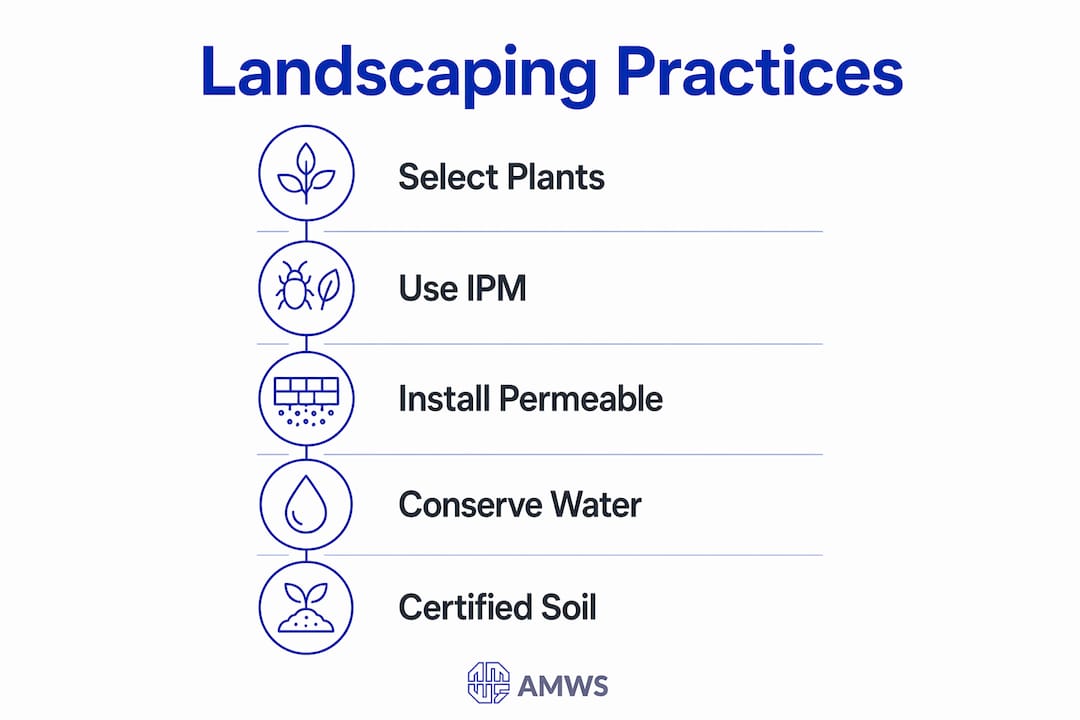
Eco-conscious landscaping practices commonly include IPM, native plants, permeable surfaces, recycled materials, and low-emission equipment. Each of these addresses a specific environmental pressure point, from chemical runoff to urban heat. No single practice qualifies a business as truly sustainable. The US EPA positions eco-conscious landscaping as a portfolio of methods, not a single product claim.
Integrated Pest Management
IPM is the standard approach for reducing chemical pesticide use on commercial sites. It combines biological controls, habitat manipulation, and targeted pesticide application only when monitoring confirms a threshold has been crossed. For landscape businesses, IPM reduces liability from chemical exposure and lowers long-term input costs. Clients in regulated industries, such as healthcare and education, increasingly require IPM documentation before awarding contracts.
Native and climate-appropriate plants
Native plant landscaping reduces irrigation demand, fertilizer use, and maintenance frequency. Plants selected for local climate conditions establish faster and tolerate drought without supplemental watering. Applying mulch 3–4 inches deep and planting drought-tolerant turfgrass suited to local conditions further reduces water needs and fertilizer use. This directly cuts your operating costs while improving site resilience.

Permeable surfaces and recycled materials
Permeable paving, gravel beds, and recycled aggregate replace impervious surfaces that cause stormwater runoff. Deep-rooted native plants provide filtration at the soil level. One SITES case study documented 60% native plant coverage achieving measurable runoff reduction on a commercial site. That result is replicable on any project where plant selection and grading are coordinated from the design phase.
Here is a summary of the core practices and their primary business benefit:
- IPM: Reduces chemical input costs and supports compliance documentation
- Native plants: Lowers irrigation and fertilizer demand, increases site resilience
- Mulch and drought-tolerant turf: Cuts water use and reduces fertilizer runoff
- Permeable surfaces: Controls stormwater and reduces runoff liability
- Recycled materials: Lowers material costs and supports green building credits
- Low-emission equipment: Reduces air quality impact and meets local ordinances
Pro Tip: Combining native plant selection with permeable surfaces on the same project creates a compounding effect. You reduce both water demand and runoff simultaneously, which strengthens your case for SITES or LEED credit documentation.
How to implement water-efficient irrigation in your landscaping business
Water-efficient irrigation is the single highest-impact operational change a landscaping business can make. The EPA’s WaterSense program recommends smart watering controllers, specifically weather-based and soil-moisture sensor models, as the baseline for any commercial irrigation system. These controllers adjust run times automatically based on real conditions, eliminating the guesswork that causes overwatering and runoff.
Follow these steps to implement water-efficient irrigation across your projects:
- Audit existing systems first. Before installing new equipment, conduct a site audit to identify broken heads, misaligned zones, and scheduling errors. Most commercial sites waste water through fixable mechanical failures, not design flaws.
- Design irrigation zones by plant type and microclimate. Group plants with similar water needs on the same zone. A shaded bed and a south-facing slope should never share a valve. Mismatched zones are the leading cause of both overwatering and underwatering on the same property.
- Install WaterSense-labeled controllers. Weather-based controllers use local evapotranspiration data to set run times. Soil-moisture sensors halt irrigation when the root zone is already saturated. Both approaches prevent sprinkler overspray onto pavement, which the EPA flags as a primary source of urban water waste.
- Adjust schedules seasonally. A schedule set in july is wrong by october. Build seasonal adjustment into every maintenance contract as a line item, not an afterthought. Clients rarely adjust schedules themselves, and static programs waste water through winter and spring.
- Schedule professional audits annually. A certified irrigation auditor measures distribution uniformity and catch-can output across zones. Audits identify efficiency losses that visual inspections miss and provide documentation for water-savings claims in client reporting.
Pro Tip: Market irrigation services as a three-part package: system design, certified installation, and annual auditing. Clients who buy all three see measurable water savings. Clients who buy only installation rarely do.
What business models support eco-conscious landscaping practices?
The fastest-growing service niches in eco-conscious landscaping are smart irrigation installation, native plant gardens, and organic lawn treatments. These niches carry higher margins than standard mowing and blowing contracts because they require specialized knowledge and certified staff. Building your business around these services positions you ahead of regulatory changes and captures clients who are already seeking sustainability credentials.
Structuring your offerings around measurable outcomes is the key differentiator. Clients in commercial real estate, healthcare, and municipal sectors need to report water savings, nutrient runoff reduction, and stormwater management performance to their own stakeholders. Your service model must generate that data.
Consider these structural elements for a sustainable landscaping business:
- Certification and training: Florida’s Green Industries Best Management Practices (GI-BMPs) requires certification for commercial fertilizer applicators. Even outside Florida, completing equivalent training signals regulatory competence and reduces compliance risk.
- Certified applicator documentation: In regulated fertilizer environments, assign certified applicators to each site and maintain application records. This protects you during audits and demonstrates accountability to clients.
- Repeatable maintenance protocols: Sustainable performance degrades without systemized upkeep. Build irrigation schedule reviews, mulch replenishment, and soil testing into standard maintenance cycles.
- Outcome-based reporting: Deliver quarterly reports showing water use, fertilizer application rates, and stormwater event performance. Clients who see numbers renew contracts. Clients who see only green lawns shop on price.
- Marketing eco-credentials: Certifications, documented water savings, and SITES project credits are marketing assets. Feature them in proposals, on your website, and in case studies. Sustainability-focused clients respond to proof, not promises.
How do sustainability certifications create competitive advantage?
SITES certification uses measurable sustainability metrics including reduced water demand, enhanced biodiversity, and improved air quality to rate landscape projects. That performance-based structure is what separates SITES from a simple green label. A SITES-certified project carries documented proof of environmental outcomes, which is exactly what commercial clients need for their own ESG reporting.
SITES also integrates directly with LEED, the dominant green building rating system. Landscape projects that earn SITES credits can contribute to a building’s LEED certification, making your work part of a larger sustainability story. That integration opens doors to architecture firms, developers, and institutional clients who are already working within LEED frameworks.
| Certification | Primary focus | Business benefit |
|---|---|---|
| SITES | Landscape sustainability performance | ESG documentation, LEED integration |
| WaterSense | Water-efficient products and practices | Irrigation marketing, audit readiness |
| GI-BMPs (Florida) | Fertilizer compliance and best practices | Regulatory compliance, contract eligibility |
Pursuing SITES certification requires ongoing soil testing and adaptive maintenance planning, particularly on challenging sites. The certification is not a one-time achievement. It demands sustained performance, which means your maintenance protocols must be built to support it from day one.
Key Takeaways
Eco-conscious landscaping businesses that combine IPM, native plants, WaterSense irrigation, and SITES certification deliver measurable environmental outcomes that win and retain commercial contracts.
| Point | Details |
|---|---|
| Build a practice portfolio | Combine IPM, native plants, permeable surfaces, and low-emission equipment for credible sustainability claims. |
| Sell irrigation as a service package | Include system design, certified installation, and annual auditing to deliver measurable water savings. |
| Pursue certification strategically | SITES and GI-BMPs credentials reduce compliance risk and open access to ESG-focused commercial clients. |
| Document outcomes for clients | Quarterly reports on water use and runoff performance turn sustainability into a contract renewal tool. |
| Train and certify your staff | Certified applicators and trained crews protect your business during regulatory audits and strengthen client trust. |
Why I think most landscaping businesses underinvest in maintenance systems
Most landscape businesses I encounter treat eco-conscious practices as a sales pitch rather than an operating system. They install a WaterSense controller, plant a few natives, and call it sustainable. Six months later, the irrigation schedule has not been adjusted, the mulch has thinned to an inch, and the native plants are competing with weeds. The environmental performance is gone, but the marketing language stays on the website.
The businesses that actually build lasting value in this space treat soil health and irrigation auditing as non-negotiable maintenance line items. They train staff to recognize performance degradation before clients notice it. They use certifications as internal quality standards, not just external marketing tools.
Electric equipment is the next frontier worth investing in now. Battery-powered mowers, blowers, and edgers have reached commercial-grade performance levels. Clients in noise-sensitive environments, such as hospitals and office parks, actively prefer them. The operational cost savings over a fleet lifecycle are real and documentable.
The businesses that will lead this market in the next five years are not the ones with the greenest brochures. They are the ones with the most disciplined maintenance protocols and the clearest performance data.
— MOHAMED AWAD
AMWS Group’s approach to sustainable commercial landscaping
AMWS Group delivers commercial landscaping services built around ecologically safe products and practices that protect both the environment and public health. Every maintenance plan is developed through direct client communication and executed by a trained team that understands the difference between a green appearance and genuine environmental performance.
For commercial property owners and landscape architects who need a reliable partner for sustainable grounds care, AMWS Group offers commercial maintenance programs that include irrigation management, native plant care, and documented outcome reporting. The company’s 24/7 support model means performance issues are addressed before they become compliance problems. Contact AMWS Group to discuss a maintenance plan built around your sustainability goals.
FAQ
What are eco-conscious landscaping practices for businesses?
Eco-conscious landscaping practices include IPM, native plant selection, water-efficient irrigation, permeable surfaces, and low-emission equipment. The US EPA identifies these as the core methods for reducing environmental impact on commercial sites.
How does WaterSense help landscaping businesses save water?
WaterSense recommends weather-based and soil-moisture controllers that automatically adjust irrigation based on real conditions. Seasonal schedule adjustments and preventing sprinkler overspray onto pavement are also key water-saving measures.
What is SITES certification and why does it matter?
SITES is a performance-based rating system that measures landscape sustainability through metrics like water use reduction, biodiversity, and air quality improvement. It integrates with LEED, making it valuable for commercial and institutional project teams.
Do landscaping businesses need certification to offer eco-friendly services?
Certification requirements vary by region. Florida’s GI-BMPs program requires certification for commercial fertilizer applicators, and similar regulations are expanding in other states. Certification reduces compliance risk and strengthens your credibility with sustainability-focused clients.
How do I market sustainable landscaping services to commercial clients?
Frame your services around measurable outcomes: water savings, nutrient runoff reduction, and stormwater management data. Commercial clients in real estate, healthcare, and municipal sectors need documented performance for their own ESG reporting, not just a green appearance.